
Summer Fish
The 8 kinds landed at Nakaminato this season.
-

Abalone
Spring Fish Summer Fish Autumn Fish- Features
-
Around 100 species worldwide, with about 10 species found in Japan.
Nocturnal, it hides under rocks or in crevices during the day.
- How to choose
-
Press the center of the flesh; a good one barely moves. Limp, sagging ones are no good.
- Size
-
5–20 cm
- Types
-
Kuro abalone, megai abalone, Ezo abalone, tokobushi (small abalone)
- How to eat
-
Sashimi, grilled, steamed, simmered, or Western-style
-
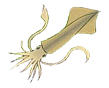
Squid
Spring Fish Summer Fish Autumn Fish Winter Fish- Features
-
Squid eaten in Japan fall into four families: cuttlefish, spear squid, neon flying squid, and firefly squid.
Many kinds are edible, and nearly the whole body is used except for the cartilage and beak.
Most kinds are said to live only about a year.
- How to choose
-
Choose ones with clear, black eyes
- Size
-
25 cm or more
- Types
-
Japanese flying squid, spear squid, golden cuttlefish, bigfin reef squid, swordtip squid, neon flying squid, firefly squid
- How to eat
-
Sashimi, simmered, grilled, deep-fried, or Western-style
-
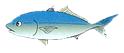
Young yellowtail (inada)
Summer Fish Autumn Fish- Features
-
A "promotion fish" whose name changes as it grows, and also varies by region.
- Size
-
In the Kanto region, ones under 40 cm are called inada. In the Kansai region they are called hamachi.
- How to eat
-
Sashimi, grilled, or simmered
-

Bai shellfish (Japanese ivory shell / whelk)
Spring Fish Summer Fish- Features
-
Covered with a grayish-yellow shell skin. The shell is soft, so it can be cracked open and the meat easily removed.
Once the slime is removed and the innards are properly cleaned, bai-shellfish sashimi has a pleasant texture and a sweet, delicious taste.
- Size
-
5 cm
- How to eat
-
Sashimi, steamed in sake, or simmered
-
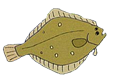
Righteye flounder (karei)
Summer Fish Autumn Fish Winter Fish- Features
-
Both eyes are on the right side of the body. About 40 species are found around Japan.
It lives on sandy-muddy bottoms shallower than about 100 m.
To tell karei from hirame, remember: "hirame face left, karei face right"!
- How to choose
-
Choose thick-fleshed ones without whitish blotches
- Size
-
45–90 cm
- Types
-
Brown sole, marbled sole, spotted halibut, Greenland halibut, Alaska plaice, ridged-eye flounder
- How to eat
-
Sashimi, simmered, grilled, deep-fried, or Western-style
-
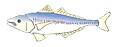
Japanese horse mackerel (ma-aji)
Spring Fish Summer Fish- Features
-
There are about 140 species of horse mackerel and relatives worldwide.
They form large schools from the coast to offshore waters.
In Japan they are an important food fish, caught in large quantities by many methods such as set nets, purse seines, drag nets, gill nets, and line fishing.
- How to choose
-
Choose ones with clear, black eyes and firm flesh.
- Size
-
20–50 cm
- Types
-
Japanese horse mackerel, brownstriped mackerel scad, yellowtail horse mackerel, kusaya-moro, slender scad
- How to eat
-
Sashimi, grilled, dried, deep-fried, or simmered
-
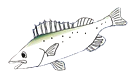
Japanese sea bass (suzuki)
Summer Fish- Features
-
A "promotion fish" whose name changes as it grows; the standards and names also vary by region.
In the Kanto region: around 5 cm "hikarigo," around 10 cm "koppa," around 25 cm "seigo," 40–60 cm two- to three-year fish "fukko," and four- to five-year fish over 60 cm "suzuki."
The flesh is a firm, springy white with almost no bloodline.
- Size
-
60 cm or more
- How to eat
-
Sashimi, grilled, steamed, or Western-style
-

Octopus
Summer Fish Autumn Fish Winter Fish- Features
-
Japan accounts for about 60% of the world's octopus consumption.
It lives in burrows dug in the sandy-muddy bottom. By day it stays still in its den, and at night it becomes active in search of prey such as shrimp, crab, and bivalves.
Domestic common octopus is in short supply, so most octopus consumed in Japan is from Africa or Hokkaido.
- How to choose
-
For raw octopus, choose ones with firm suckers. For boiled octopus, choose ones with legs curled up tightly.
- Size
-
30–100 cm. Giant Pacific octopus from Hokkaido can exceed 3 m.
- Types
-
Common octopus, giant Pacific octopus, ocellated octopus (iidako)
- How to eat
-
Sashimi, simmered, steamed, vinegared, takoyaki, oden ingredient, or in vinegared dishes