
Winter Fish
The 11 kinds landed at Nakaminato this season.
-
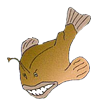
Anglerfish (monkfish)
Autumn Fish Winter Fish- Features
-
Around 200 species live in seas worldwide, with about 60 species in Japan.
It lies partly buried in the sandy-muddy seabed and wiggles a lure-like esca to draw prey close to its huge mouth, then swallows it whole.
In some species, the male lives as a parasite attached to the female.
- Size
-
About 1–1.5 m
- Types
-
Yellow goosefish, blackmouth angler, black anglerfish, deep-sea anglerfish
- How to eat
-
Anglerfish hot pot is the classic dish; the liver, called ankimo, is a prized delicacy said to rival foie gras.
-
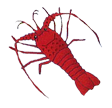
Japanese spiny lobster (ise-ebi)
Autumn Fish Winter Fish- Features
-
Found along the Pacific coast from Ibaraki Prefecture to Kyushu, and on to the Ryukyus and Taiwan. It lives in groups in the shade of shallow-water reefs.
Its striking shape makes it indispensable for celebrations.
- How to choose
-
A fresh one moves vigorously and curls its tail inward.
- Size
-
Around 30 cm
- How to eat
-
Sashimi, grilled (onigara-yaki, grilled in the shell), or steamed
-
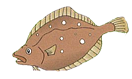
Flounder (hirame)
Autumn Fish Winter Fish- Features
-
Ibaraki Prefecture's official fish, and a fish for all four seasons.
Both eyes are on the left side. A leading white-fleshed fish. It has a large mouth with sharp, big teeth, and eats other fish, squid, shrimp, and crab.
In other prefectures, Aomori and Tottori have also designated it their official fish.
The muscle at the base of the dorsal and anal fins, called engawa, is used for sushi. It is firm, fatty, and delicious.
- How to choose
-
Choose ones with firm, taut flesh.
- Size
-
80 cm
- How to eat
-
Sashimi, grilled, simmered, or deep-fried
-
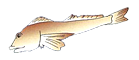
Bluefin searobin (houbou / gurnard)
Spring Fish Winter Fish- Features
-
It lives on the sandy-muddy bottom from the continental shelf to the upper continental slope, spreading its pectoral fins to glide across the seabed.
It makes a croaking sound by contracting its swim bladder.
The body is a pale crimson, and its large pectoral fins are a vivid cobalt blue.
- Size
-
30–40 cm
- How to eat
-
Sashimi, simmered, grilled, deep-fried, or Western-style
-
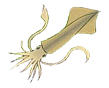
Squid
Spring Fish Summer Fish Autumn Fish Winter Fish- Features
-
Squid eaten in Japan fall into four families: cuttlefish, spear squid, neon flying squid, and firefly squid.
Many kinds are edible, and nearly the whole body is used except for the cartilage and beak.
Most kinds are said to live only about a year.
- How to choose
-
Choose ones with clear, black eyes
- Size
-
25 cm or more
- Types
-
Japanese flying squid, spear squid, golden cuttlefish, bigfin reef squid, swordtip squid, neon flying squid, firefly squid
- How to eat
-
Sashimi, simmered, grilled, deep-fried, or Western-style
-
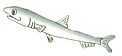
Japanese anchovy (katakuchi-iwashi)
Autumn Fish Winter Fish- Features
-
Sardines and their relatives number about 270 species in the world's shallow seas and about 70 in fresh water. Around 27 species live along Japan's coasts.
Its upper jaw is much larger than its lower jaw, giving it a one-sided mouth, which is how it got its Japanese name.
- Size
-
Around 20 cm
- How to eat
-
Widely used as an ingredient for dried baby sardines (niboshi) and dried whitebait (shirasu-boshi).
-

Crab
Spring Fish Autumn Fish Winter Fish- Features
-
There are about 1,000 species.
Among those landed at Nakaminato, the "hira-tsume crab" (also called ecchi crab) is especially tasty. It is named for the H-shaped hollow on its shell.
Red king crab is found in eastern Hokkaido, the southwestern Sea of Japan to the Sea of Okhotsk, and the Alaskan coast.
Snow crab ranges from the Sea of Japan and Hokkaido to Alaska and the west coast of North America. In Japan, the "matsuba crab" of the San'in region and the "echizen crab" caught off Fukui are famous.
- How to choose
-
Choose ones with all claws and legs intact that feel heavy for their size.
- How to eat
-
Red king crab, snow crab, hair crab, swimming crab, Shanghai (mitten) crab
-
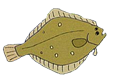
Righteye flounder (karei)
Summer Fish Autumn Fish Winter Fish- Features
-
Both eyes are on the right side of the body. About 40 species are found around Japan.
It lives on sandy-muddy bottoms shallower than about 100 m.
To tell karei from hirame, remember: "hirame face left, karei face right"!
- How to choose
-
Choose thick-fleshed ones without whitish blotches
- Size
-
45–90 cm
- Types
-
Brown sole, marbled sole, spotted halibut, Greenland halibut, Alaska plaice, ridged-eye flounder
- How to eat
-
Sashimi, simmered, grilled, deep-fried, or Western-style
-
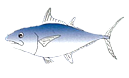
Tuna
Autumn Fish Winter Fish- Features
-
They form large schools and migrate mainly in the open ocean. The fastest can swim at around 100 km/h.
The bluefin tuna, the largest of the tunas, also has the finest flavor. Small bluefin are called meji-maguro.
The bigeye tuna is aptly named for its large eyes, and is also nicknamed "daruma."
The albacore has long pectoral fins and a somewhat smaller body, and is also called "tombo."
- Size
-
About 1–3 m, reaching 30–700 kg
- Types
-
*Landed at Nakaminato: bigeye tuna, meji (young bluefin) tuna, albacore *Others: bluefin tuna, southern bluefin tuna (Indian tuna)
- How to eat
-
Sashimi or grilled
19-8 Minato-honcho, Hitachinaka City, Ibaraki Prefecture
-
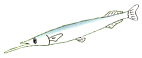
Japanese halfbeak (sayori)
Spring Fish Winter Fish- Features
-
It lives in schools near the surface close to shore.
A long, slender lower jaw is its trademark, with a vermilion tip.
It is treated as a high-grade white-fleshed fish.
- How to choose
-
A silvery, shining body is proof of freshness. If the belly sags and turns brownish when opened, the fish is old.
- Size
-
40 cm
- How to eat
-
Sashimi, grilled, dried, deep-fried, or Western-style
-
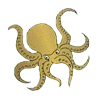
Octopus
Summer Fish Autumn Fish Winter Fish- Features
-
Japan accounts for about 60% of the world's octopus consumption.
It lives in burrows dug in the sandy-muddy bottom. By day it stays still in its den, and at night it becomes active in search of prey such as shrimp, crab, and bivalves.
Domestic common octopus is in short supply, so most octopus consumed in Japan is from Africa or Hokkaido.
- How to choose
-
For raw octopus, choose ones with firm suckers. For boiled octopus, choose ones with legs curled up tightly.
- Size
-
30–100 cm. Giant Pacific octopus from Hokkaido can exceed 3 m.
- Types
-
Common octopus, giant Pacific octopus, ocellated octopus (iidako)
- How to eat
-
Sashimi, simmered, steamed, vinegared, takoyaki, oden ingredient, or in vinegared dishes