
Spring Fish
The 10 kinds landed at Nakaminato this season.
-

Abalone
Spring Fish Summer Fish Autumn Fish- Features
-
Around 100 species worldwide, with about 10 species found in Japan.
Nocturnal, it hides under rocks or in crevices during the day.
- How to choose
-
Press the center of the flesh; a good one barely moves. Limp, sagging ones are no good.
- Size
-
5–20 cm
- Types
-
Kuro abalone, megai abalone, Ezo abalone, tokobushi (small abalone)
- How to eat
-
Sashimi, grilled, steamed, simmered, or Western-style
-
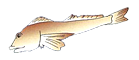
Bluefin searobin (houbou / gurnard)
Spring Fish Winter Fish- Features
-
It lives on the sandy-muddy bottom from the continental shelf to the upper continental slope, spreading its pectoral fins to glide across the seabed.
It makes a croaking sound by contracting its swim bladder.
The body is a pale crimson, and its large pectoral fins are a vivid cobalt blue.
- Size
-
30–40 cm
- How to eat
-
Sashimi, simmered, grilled, deep-fried, or Western-style
-
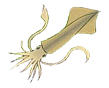
Squid
Spring Fish Summer Fish Autumn Fish Winter Fish- Features
-
Squid eaten in Japan fall into four families: cuttlefish, spear squid, neon flying squid, and firefly squid.
Many kinds are edible, and nearly the whole body is used except for the cartilage and beak.
Most kinds are said to live only about a year.
- How to choose
-
Choose ones with clear, black eyes
- Size
-
25 cm or more
- Types
-
Japanese flying squid, spear squid, golden cuttlefish, bigfin reef squid, swordtip squid, neon flying squid, firefly squid
- How to eat
-
Sashimi, simmered, grilled, deep-fried, or Western-style
-

Bai shellfish (Japanese ivory shell / whelk)
Spring Fish Summer Fish- Features
-
Covered with a grayish-yellow shell skin. The shell is soft, so it can be cracked open and the meat easily removed.
Once the slime is removed and the innards are properly cleaned, bai-shellfish sashimi has a pleasant texture and a sweet, delicious taste.
- Size
-
5 cm
- How to eat
-
Sashimi, steamed in sake, or simmered
-

Crab
Spring Fish Autumn Fish Winter Fish- Features
-
There are about 1,000 species.
Among those landed at Nakaminato, the "hira-tsume crab" (also called ecchi crab) is especially tasty. It is named for the H-shaped hollow on its shell.
Red king crab is found in eastern Hokkaido, the southwestern Sea of Japan to the Sea of Okhotsk, and the Alaskan coast.
Snow crab ranges from the Sea of Japan and Hokkaido to Alaska and the west coast of North America. In Japan, the "matsuba crab" of the San'in region and the "echizen crab" caught off Fukui are famous.
- How to choose
-
Choose ones with all claws and legs intact that feel heavy for their size.
- How to eat
-
Red king crab, snow crab, hair crab, swimming crab, Shanghai (mitten) crab
-
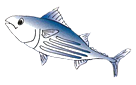
Skipjack tuna (bonito)
Spring Fish Autumn Fish- Features
-
In spring, the lean, light-tasting "first bonito" (hatsu-gatsuo); in autumn, the rich, fatty "returning bonito" (modori-gatsuo) — enjoyable twice a year. Returning bonito has about 10 times the fat of first bonito!
It migrates mainly in the open ocean in large schools, and has a habit of swimming alongside large whales and sharks.
The stripes on its belly are not clearly visible while it is alive.
There is even a classic haiku praising its flavor, showing it has long been considered delicious.
- How to choose
-
Choose ones with clear belly stripes and gills of a vivid red.
- Size
-
50–120 cm (40–65 cm is typical)
- How to eat
-
Sashimi, seared tataki, or simmered *Also made into katsuobushi (dried bonito flakes) *Usually eaten with ginger rather than wasabi, and sometimes with garlic (grated or sliced).
-
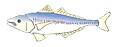
Japanese horse mackerel (ma-aji)
Spring Fish Summer Fish- Features
-
There are about 140 species of horse mackerel and relatives worldwide.
They form large schools from the coast to offshore waters.
In Japan they are an important food fish, caught in large quantities by many methods such as set nets, purse seines, drag nets, gill nets, and line fishing.
- How to choose
-
Choose ones with clear, black eyes and firm flesh.
- Size
-
20–50 cm
- Types
-
Japanese horse mackerel, brownstriped mackerel scad, yellowtail horse mackerel, kusaya-moro, slender scad
- How to eat
-
Sashimi, grilled, dried, deep-fried, or simmered
-
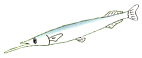
Japanese halfbeak (sayori)
Spring Fish Winter Fish- Features
-
It lives in schools near the surface close to shore.
A long, slender lower jaw is its trademark, with a vermilion tip.
It is treated as a high-grade white-fleshed fish.
- How to choose
-
A silvery, shining body is proof of freshness. If the belly sags and turns brownish when opened, the fish is old.
- Size
-
40 cm
- How to eat
-
Sashimi, grilled, dried, deep-fried, or Western-style
-
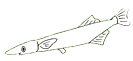
Shirasu (young sardines/anchovies)
Spring Fish Autumn Fish- Features
-
A general term for the larvae and juveniles of various fish; the young of sardine relatives are called "shirasu." They are eaten raw, or boiled in salt water to make kama-age (freshly boiled) or dried whitebait.
- Size
-
2–3 cm
- How to eat
-
Raw, or boiled and dried
-
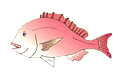
Sea bream (tai)
Spring Fish Autumn Fish- Features
-
Rich in variety. Worthy of the title "king of fish," it is considered auspicious and often appears at celebratory occasions.
During spawning season, the females are also called "cherry-blossom sea bream" (sakura-dai).
Red sea bream (madai) and crimson sea bream (chidai) look alike in their red color; to tell them apart, madai has a black-edged tail fin, while chidai does not.
The black sea bream (kurodai) closely resembles madai, looking like a blackened version of it. It is also called "chinu."
A mild white flesh with rich umami; the firm flesh is delicious cooked any way.
- How to choose
-
Fresh ones have vivid blue spots.
Choose ones with firm scales.
- Size
-
20–100 cm
- Types
-
Red sea bream, crimson sea bream, black sea bream, yellowback sea bream
- How to eat
-
Sashimi, grilled, steamed, simmered, or Western-style